

Citation
L'auteur
Charles Ngando Black
(cngando@msn.com) - Institute for Data & AI Practices
Copyright
Déclaration d'intérêts
Financements
Aperçu
The Problem: Standardized data governance approaches are failing. Recurrent projects are abandoned, systems are bypassed, and significant investments yield no measurable return.
Our Solution: This article moves beyond the critique of universal models to propose a new navigational compass based on organizational typology. We reveal how five core dimensions combine to define eleven distinct organizational archetypes:
- Organizational Complexity (informal structures vs. global formal systems)
- Information Criticality (risk tolerance vs. absolute security)
- Institutional Maturity (established stability vs. adaptive plasticity)
- Available Capacities (financial, human, and operational resources)
- Core Organizational Mission (regulation, performance, innovation, or public interest)
The Impact: Each archetype demands a tailored governance strategy. This typology provides practitioners with a practical framework to orient their strategy and design legitimate, adaptable governance systems. It offers concrete principles for action, turning apparent organizational constraints into levers for efficiency and successful digital transformation.
Contenu
Data governance is facing a crisis of relevance. Despite a proliferation of frameworks, certifications, and best practices, failures accumulate across all sectors. This situation reveals a fundamental misunderstanding: governing data is not a technical problem with a universal technical solution.
It is an organizational challenge that requires engaging with irreducibly diverse realities: inherited corporate cultures, sector-specific regulations, internal power dynamics, available resources, and context-specific strategic issues. Organizations are not minor variations on a single model but singular ecosystems with their own logics of action and legitimization mechanisms.
The illusion of « one-size-fits-all » persists, fueled by a fascination with success stories from exceptional organizations and the seductive promise of a universally applicable miracle method. This illusion is costly: it diverts attention from the real challenges of contextualization and leads to applying unsuitable solutions to poorly understood problems.
It is time to think about governance differently: not as the mechanical application of a pre-established model, but as the delicate art of working with organizational singularity to build legitimate and sustainable systems.
The Dead End of the Universal Model
When the Solution Becomes the Problem
Standardized governance approaches rest on a flawed premise: that organizations differ only superficially. They offer normative systems to be marginally adapted to supposedly similar contexts. This mechanistic view ignores a richer organizational reality.
Each organization is a unique ecosystem of institutional constraints, strategic opportunities, and historically constructed logics of action. For example, a multinational bank applying its prudential, regulatory data governance to a newly acquired tech subsidiary will create paralysis in a context that requires velocity, experimentation, and rapid iteration.
An Incomplete First Adjustment
Recognition of different governance architectures (centralized, decentralized, federated) was a first step. Newer approaches like data mesh push governance responsibility to business domains.
Yet, this adjustment remains largely formal. These models, focused on decision rights, fail to capture internal logics, real capacities, and legitimacy mechanisms. Data mesh itself, despite its disruptive claims, relies on assumptions rarely met (domain autonomy, a culture of shared responsibility, sufficient technical maturity). It promotes another universal response to fundamentally situated problems.
Diversity as Signal, Not Noise
Organizational differences must not be seen as obstacles to overcome but as signals revealing specific logics of action, shaped by history, culture, and context. Truly effective governance must work with these endogenous dynamics, not against them.
This recognition of diversity as a resource paves the way for more sophisticated and sustainable approaches to data governance.
The Blind Spots of Dominant Frameworks
Universal Models for Imaginary Organizations
Major frameworks (DAMA-DMBOK, DCAM, DGI, COBIT, ISO 38505) offer methodically organized normative structures. Their advantage is theoretical coherence.
Their critical flaw? They are designed for an abstract, generic organization. They systematically ignore three fundamental elements:
- Plurality of Rationalities: Organizations prioritize different goals—compliance, velocity, economic performance, or stability—which deeply condition governance design.
- Heterogeneity of Existing Architectures: Centralized, distributed, and hybrid models are not equivalent and require differentiated approaches.
- Institutional & Political Determinants: Internal power plays, local histories, and legitimacy struggles shape organizational life more than abstract processes.
Systemic Effects of Inadequacy
This blindness leads to predictable, recurrent failures: inoperable systems, disengaged actors, bureaucratic overload without added value, and a rapid loss of credibility for governance initiatives. These failures are not primarily due to poor execution or resistance to change, but to a structural gap between the frameworks’ implicit assumptions and lived organizational reality.
The Drivers of Organizational Differentiation: A Compass for Action
Five Structuring Dimensions
Comparative analysis reveals that five factors strategically and operationally define organizational diversity beyond traditional sectorial classifications.
- Complexity: Can coordination rely on informal relationships or does it require global formal systems?
- Criticality: Is risk tolerance acceptable or are the consequences of failure catastrophic?
- Maturity: Is the structure defined by stability or by adaptive plasticity?
- Capacity: What financial, human, operational resources and margins for maneuver are available?
- Mission: Is the core purpose regulation, performance, innovation, or public service?
Towards a Map of Archetypes
These five dimensions interact to form specific organizational configurations. A systematic analysis of these interactions reveals eleven distinct organizational archetypes, each with specific constraints, levers, coherent logics of action, and differentiated margins for maneuver.
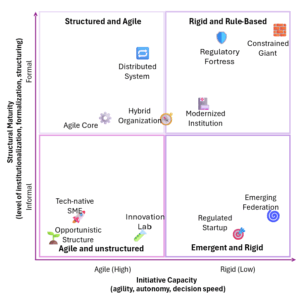
The eleven archetypes allow for the identification of specific governance trajectories, without hierarchy. Each has vulnerabilities to compensate for and strengths to build upon.
- The Constrained Colossus: Calls for progressive governance, leveraging institutional legitimacy and anchoring in existing processes. Risk: excessive formalism.
- The Regulatory Fortress: Imposes governance based on traceability, auditability, and compliance. Risk: entrapment in purely normative logics.
- The Modernized Institution: Is in transition; governance is used to structure evolution. Risk: remaining confined to siloes without active support from leadership.
- The Emerging Federation: Requires a federative governance: light, adaptable, with common principles. Challenge: harmonization without recentralization.
- The Regulated Startup: Combines operational agility with strong external constraints. Governance must be lean but solid, reassuring regulators without harming reactivity.
- The Opportunistic Structure: Often in growth or transition, can use governance to avoid loss of control. Risk: unstable responsibilities and lack of a medium-term vision.
- The Tech-Native SME: Benefits from a strong performance culture; governance can be a scalability lever. Risk: disrupting business flows.
- The Innovation Lab: Requires experimental, evolutive governance focused on reproducibility, ethics, and scalability. Risk: isolated initiatives without bridges to production.
- The Agile Core: Values governance as operational support for documentation and decision security. Challenge: avoiding hyper-contextualization at the expense of global coherence.
- The Hybrid Organization: Combines several conflicting logics. Governance can act as a stabilizer by accepting pluralistic rhythms and modes.
- The Distributed System: Imposes explicit governance of responsibilities, exchange contracts, and technical interfaces. Effectiveness depends on orchestration, not centralization.
This typology offers a realistic and operationalizable analytical framework for adapting data governance to each organizational context, overcoming the limits of universalist approaches.
Governance as a System of Adjustments
Three Organizations, Three Logics
The concrete analysis of practices shows how the same functional requirement can lead to radically different implementations. Take the simple example of data documentation.
- In a Constrained Colossus, it serves public traceability and compliance (exhaustive, standardized).
- In a Regulatory Fortress, it serves legal security and risk coverage (precise, defensive).
- In an Innovation Lab, it serves knowledge capitalisation and reuse (accessible, collaborative).
Same requirement, three implementations, three organizational purposes. This diversity is not a malfunction but the expression of logics coherent with each context’s specificities.
The Art of Integration
Efficient governance cannot just be added to existing structures. It must integrate organically:
- Technically: With the in-place enterprise architecture (complex legacy or agile cloud-native infrastructures).
- Processually: Into critical business workflows, enhancing value and reliability without degrading fluidity.
- Decisionally: Into organizational decision circuits, becoming a true support for strategic choices.
This triple integration—technical, processual, decisional—determines the difference between a mechanically applied governance and one lived as an organizational resource.
Towards Context-Aware Governance
Emerging Hybrid Models
Facing the limits of standardized approaches, the most advanced organizations are experimenting more sophisticated, contextualized modes of data governance. These innovations give rise to hybrid models combining the advantages of formal structure with the flexibility for contextual adaptation.
- Federated Governance organizes coordination between autonomous entities while preserving their initiative.
- Agile Governance transposes software agility principles to data, prioritizing rapid iteration.
- Distributed Governance trusts collective intelligence and self-regulation over centralized control.
- Mission-Driven Governance structures action around shared business objectives rather than abstract process compliance.
These emerging approaches abandon pure standardization for more plastic, situated forms, capable of adapting to specificities while maintaining necessary overall coherence.
Conditions for Success
Analysis of current experiments reveals three critical success factors for these new governance approaches:
- Legitimacy: It must be perceived as acceptable and valuable by stakeholders in their daily activity.
- Adaptability: In a permanently evolving environment, rigid governance becomes obsolete. The ability to adjust is key to durability.
- Integration: Governance that remains external to critical processes cannot achieve significant impact. Its anchoring in value-creation mechanisms conditions its longevity.
It is at the dynamic intersection of these three dimensions—legitimacy, adaptability, and integration—that sustainable governance is built, capable of weathering organizational and technological changes without losing relevance.
Conclusion
Data and AI governance is entering a phase of conceptual and practical maturity. The challenge is no longer the mechanical generalization of supposed universal best practices, but their intelligent contextualization to organizational specificities. Approaches based on a typology of organizational archetypes enable this fundamental paradigm shift.
The goal is no longer to apply a ready-to-wear model to diverse realities, but to orchestrate a living governance—situated in its context, legitimate in the eyes of its stakeholders, and sufficiently evolutive to support future transformations. This conceptual revolution opens the way to more effective, durable, and respectful practices that honor the organizational diversity defining the contemporary economic landscape.
Bibliographie
Abraham, R., Schneider, J., & vom Brocke, J. (2019). Data and AI governance: A conceptual framework, structured review, and research agenda. International Journal of Information Management, 49, 424–438. https://doi.org/10.1016/j.ijinfomgt.2019.07.008
Alhassan, I., Sammon, D., & Daly, M. (2016). Data and AI governance activities: An analysis of the literature. Journal of Decision Systems, 25(sup1), 64–75. https://doi.org/10.1080/12460125.2016.1187397
Burton-Jones, A., & Grange, C. (2013). From use to effective use: A representation theory perspective. Information Systems Research, 24(3), 632–658. https://doi.org/10.1287/isre.1120.0444
Janssen, M., Brous, P., Estevez, E., Barbosa, L. S., & Janowski, T. (2020). Data and AI governance: Organizing data for trustworthy Artificial Intelligence. Government Information Quarterly, 37(3), 101493. https://doi.org/10.1016/j.giq.2020.101493
Koltay, T. (2016). Data and AI governance, data literacy and the management of data quality. IFLA Journal, 42(4), 303–312. https://doi.org/10.1177/0340035216672238
Ladley, J. (2019). Data and AI governance: How to Design, Deploy, and Sustain an Effective Data and AI governance Program (2nd ed.). Academic Press.
Lee, Y. W., Strong, D. M., Kahn, B. K., & Wang, R. Y. (2002). AIMQ: A methodology for information quality assessment. Information & Management, 40(2), 133–146. https://doi.org/10.1016/S0378-7206(02)00043-5
Luftman, J., Lyytinen, K., & Zvi, T. B. (2017). Enhancing the measurement of IT business alignment and its influence on company performance. Journal of Information Technology, 32(1), 26–46. https://doi.org/10.1057/jit.2015.23
Mintzberg, H. (1983). Structure in Fives: Designing Effective Organizations. Prentice-Hall.
Ngando Black, C. (2025). Connaissance des données – L’art d’opérationnaliser la gouvernance des données. Management & Datascience.
Otto, B. (2011). Organizing data and AI governance: Findings from the telecommunications industry and consequences for large service providers. Communications of the Association for Information Systems, 29, 45–66. https://doi.org/10.17705/1CAIS.02903
Parker, G. G., Van Alstyne, M. W., & Choudary, S. P. (2016). Platform Revolution: How Networked Markets Are Transforming the Economy and How to Make Them Work for You. W. W. Norton & Company.
Peppard, J., & Ward, J. (2016). The Strategic Management of Information Systems: Building a Digital Strategy (4th ed.). John Wiley & Sons.
Tallon, P. P., Ramirez, R. V., & Short, J. E. (2013). The information artifact in IT governance: Toward a theory of information governance. Journal of Management Information Systems, 30(3), 141–178. https://doi.org/10.2753/MIS0742-1222300306
Weill, P., & Ross, J. W. (2004). IT Governance: How Top Performers Manage IT Decision Rights for Superior Results. Harvard Business Review Press.
Zuboff, S. (2019). The Age of Surveillance Capitalism: The Fight for a Human Future at the New Frontier of Power. PublicAffairs.
il ne peut pas avoir d'altmétriques.)


